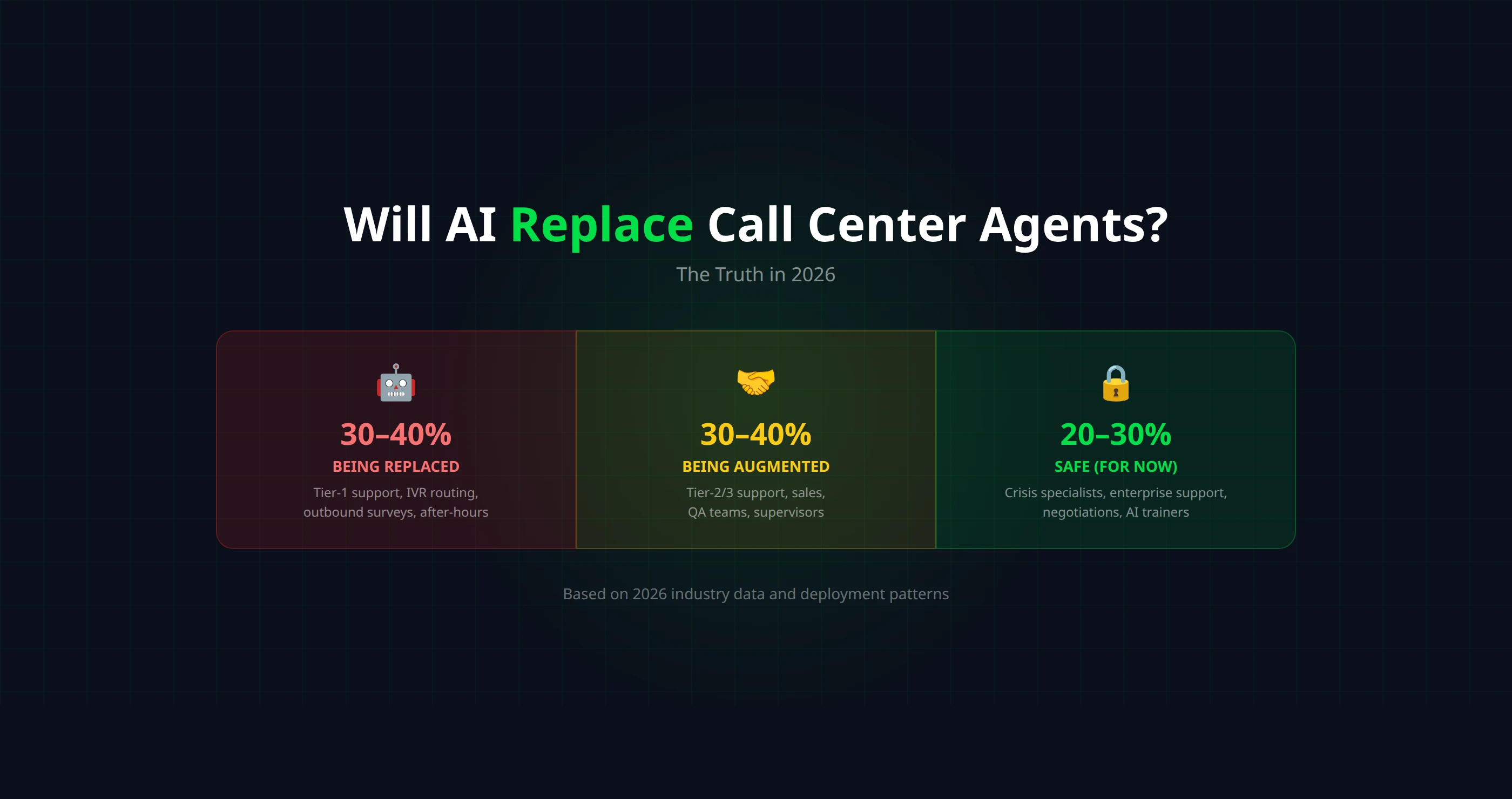
Will AI Replace Call Center Agents? The Truth in 2026
Short answer: not entirely, but the transformation is already happening. AI is eliminating some roles, augmenting others, and creating entirely new ones. This article breaks down exactly which jobs are at risk, which are safe, and how call centers are actually deploying AI right now.
Where AI in Call Centers Stands Today (2026)
AI voice agents have gone from science fiction to daily deployment. In 2026, AI handles real-time phone conversations — not just chatbot text exchanges — with sub-second response times and voices that many callers can't distinguish from humans.
But the technology isn't uniform. There's a spectrum of what AI can and can't do today:
✅ AI does well
- Answering FAQ-type questions (hours, location, pricing)
- Scheduling appointments (Calendly, CRM integrations)
- Routing calls to the right department
- Collecting caller information and screening leads
- Handling high-volume outbound campaigns (surveys, reminders)
- After-hours coverage for businesses
- Payment reminders and basic collections
❌ AI struggles with
- Emotionally charged conversations (complaints, crises)
- Complex multi-step problem resolution
- Situations requiring empathy and judgment calls
- Negotiations with no clear playbook
- Cultural nuance and context beyond the script
- Edge cases the system hasn't been trained on
- Regulatory scenarios requiring human accountability
This gap is the key to understanding the "will AI replace agents" question. AI is excellent at the routine, repetitive work that makes up 60–80% of most call center volume. It struggles with the remaining 20–40% that requires human judgment, empathy, and creative problem-solving.
Call Center Jobs AI Is Already Replacing
Let's be direct: some roles are being automated right now. If your day consists primarily of these tasks, your role is at risk:
1. Tier-1 / First-Line Support Agents
Agents who handle password resets, order status inquiries, account lookups, and basic troubleshooting. These interactions follow predictable scripts and decision trees — exactly what AI excels at. Most large contact centers have already automated 30–50% of these calls.
2. IVR Navigation and Call Routing Operators
The people who answer "press 1 for sales, press 2 for support" and manually transfer calls. AI voice agents now understand natural language intent and route calls directly, eliminating the need for human operators in this role entirely.
3. Outbound Survey and Reminder Callers
Appointment reminders, satisfaction surveys, payment reminders — any high-volume outbound task with a consistent script. AI can handle thousands of these calls simultaneously, with perfect consistency and no fatigue. One AI agent does the work of 20+ human agents.
4. After-Hours Receptionists
Night-shift agents who take messages and answer basic questions. AI receptionists provide 24/7 coverage at a fraction of the cost, with the ability to actually book appointments and route urgent calls — not just take messages.
5. Basic Lead Qualification Callers
Outbound reps who call leads and ask qualifying questions (budget, timeline, decision-maker, etc.). AI cold calling systems now handle this screening at scale, passing only qualified leads to human sales reps.
⚠️ Important nuance
"Replacing" doesn't always mean "firing." In many cases, it means those agents are retrained and moved to higher-value tasks — complex support, relationship management, or AI supervision. The role disappears; the person often doesn't.
Jobs AI Is Augmenting (Not Replacing)
For many roles, AI doesn't replace the agent — it makes them dramatically more effective. This is the "copilot" model, and it's where most of the industry is headed:
🎧 Tier-2/Tier-3 Support Agents
Complex technical support still needs humans, but AI helps by: pulling up customer history instantly, suggesting solutions based on similar past tickets, auto-summarizing the conversation, and drafting follow-up emails. Agents handle 40–60% more cases per shift.
💼 Sales Representatives
AI pre-qualifies leads before they reach a human sales rep, provides real-time conversation coaching, transcribes calls with action items, and auto-updates CRM records. Sales reps spend less time on admin and more time closing.
📊 Quality Assurance Teams
Instead of manually reviewing 2–5% of calls, AI can analyze 100% of calls for compliance, sentiment, script adherence, and customer satisfaction. QA teams shift from listening to individual calls to analyzing trends and coaching agents on patterns.
👔 Team Managers and Supervisors
AI dashboards provide real-time visibility into every conversation happening across the floor. Managers get automatic alerts when calls go sideways, predictive analytics on agent burnout, and AI-generated coaching recommendations.
The pattern is clear: AI handles the repetitive cognitive work so humans can focus on judgment, relationships, and complex decision-making. Agents who embrace AI tools become 2–3× more productive than those who resist them.
Call Center Jobs That Are Safe from AI (For Now)
🔒 Crisis and Escalation Specialists
Suicide hotlines, domestic violence support, customer de-escalation for high-value accounts — any scenario where empathy, judgment, and human connection are the core deliverable. AI may assist with routing and background research, but the conversation itself requires a human.
🔒 Complex Technical Support (Enterprise)
Troubleshooting multi-system enterprise integrations, custom configurations, or edge cases that require deep product knowledge and creative problem-solving. AI can assist, but the diagnostic thinking and solution architecture need a human expert.
🔒 High-Stakes Negotiations
Enterprise contract renewals, high-value dispute resolution, legal negotiations — situations where the financial or reputational stakes are too high for an AI to handle autonomously. Humans will handle these for at least the next decade.
🔒 AI Trainers and Supervisors (New Role)
A growing new role: people who train AI agents, review their conversations, fine-tune prompts, handle escalations from AI, and ensure quality standards. The better AI gets, the more of these roles are needed. Many former Tier-1 agents are moving into this role.
The Numbers: What Research and Data Show
Rather than speculation, here's what industry data tells us about AI's actual impact on call center employment:
30–40%
of Tier-1 call center tasks have been automated by AI as of 2026 (Gartner, McKinsey estimates). This is up from ~15% in 2023.
2–3×
productivity increase for agents using AI copilot tools — they handle more cases per hour with higher CSAT scores (Zendesk, Intercom reports).
$80B
in global contact center labor costs targeted for AI optimization by 2028. Not all eliminated — much of it redirected from routine to complex work.
What's Actually Happening at Scale
The most honest answer: headcount is shrinking at the low end and growing at the high end. Companies aren't announcing mass layoffs — they're reducing headcount through attrition (not replacing agents who leave), retraining existing staff for AI supervision roles, and hiring fewer new Tier-1 agents while adding AI-augmented Tier-2/3 positions.
The net effect on total industry employment is still debated. But the composition is shifting dramatically: fewer people doing repetitive work, more people doing complex work with AI assistance.
How Companies Are Actually Deploying AI in Call Centers
Forget the hype. Here's what real AI deployment looks like in practice across different business sizes:
Small Businesses (1–50 employees)
For small businesses, AI isn't replacing a call center — it's replacing the lack of one. Most small businesses can't afford a receptionist, so calls go to voicemail. AI answering services give them 24/7 coverage for $149–$299/month — a capability they never had before.
- Dental practices: AI handles appointment booking, insurance verification, after-hours triage
- Law firms: AI does initial intake screening, qualifies leads, books consultations
- HVAC/plumbing: AI dispatches emergency calls and captures new job requests
Mid-Market (50–500 employees)
Companies with existing small call centers are using AI to handle overflow and after-hours volume. Typical deployment: AI handles 40–60% of inbound calls (the simple ones), human agents handle the rest. Result: same or better service quality with 30–40% fewer agent hours needed.
Enterprise (500+ employees)
Large enterprises are deploying AI in phases: first as IVR replacement (natural language routing), then as Tier-1 automation, then as agent copilots. Full replacement of human agents is rare — augmentation and efficiency gains are the primary use case. The goal is to handle 2× call volume without 2× headcount.
For a deeper look at enterprise contact center automation, see our complete guide.
Realistic Timeline: What Happens from 2026 to 2030
2026 — Now
AI handles 30–40% of Tier-1 volume. Adoption accelerating among small businesses and mid-market. Most enterprise still in pilot/partial deployment. Agent copilot tools becoming standard. New role emerging: "AI conversation designer."
2027
AI handles 50–60% of Tier-1 tasks. Emotional intelligence improves significantly — AI can detect frustration and escalate before the customer asks. Voice cloning becomes so good that AI agents are virtually indistinguishable from humans. Regulatory frameworks begin forming around AI disclosure requirements.
2028–2029
AI handles 70–80% of routine call center volume. Tier-1 human agent roles largely phased out at major companies. Human agents focus exclusively on complex support, VIP accounts, and escalations. AI supervision becomes a major employment category within contact centers.
2030
The "call center agent" role has evolved into "customer experience specialist" — a higher-paid, higher-skilled position that works alongside AI. Total industry headcount is lower, but remaining roles pay better and involve more interesting work. Fully autonomous AI-only call centers exist for simple use cases.
How to Prepare: Advice for Agents and Managers
If You're a Call Center Agent
Move toward complex work
Volunteer for escalation handling, VIP accounts, and complex troubleshooting. The more judgment-heavy your work, the more AI-proof your role.
Learn AI tools
Become the person on your team who understands AI copilot tools, prompt writing, and conversation design. "AI-savvy agent" is a valuable title in 2026.
Build domain expertise
Deep knowledge in healthcare, finance, legal, or technical support makes you irreplaceable. AI can handle generic support; it can't replace someone who deeply understands a specialized industry.
If You're a Call Center Manager
Start with after-hours and overflow
Don't try to automate everything at once. Deploy AI for after-hours answering and overflow handling first. It's low-risk, high-impact, and builds organizational confidence in the technology.
Retrain, don't fire
Your best Tier-1 agents know your customers, your products, and your culture. Retrain them as AI supervisors, quality analysts, or Tier-2 specialists. The institutional knowledge is irreplaceable.
Measure everything
Deploy AI alongside human agents and compare CSAT, resolution time, first-call resolution, and cost per interaction. Data-driven decisions beat fear-based ones.
If You're a Business Owner
You don't need to build an AI call center from scratch. AI call center software platforms offer turnkey solutions that you can deploy in hours. Start with the use case that has the highest ROI for your business — usually after-hours coverage or outbound appointment reminders — and expand from there.
If you want to offer AI calling as a service to your own clients, white-label AI voice agent platforms let you launch under your own brand in 24–48 hours.


 5.0
5.0 5.0
5.0