Updated June 2026.
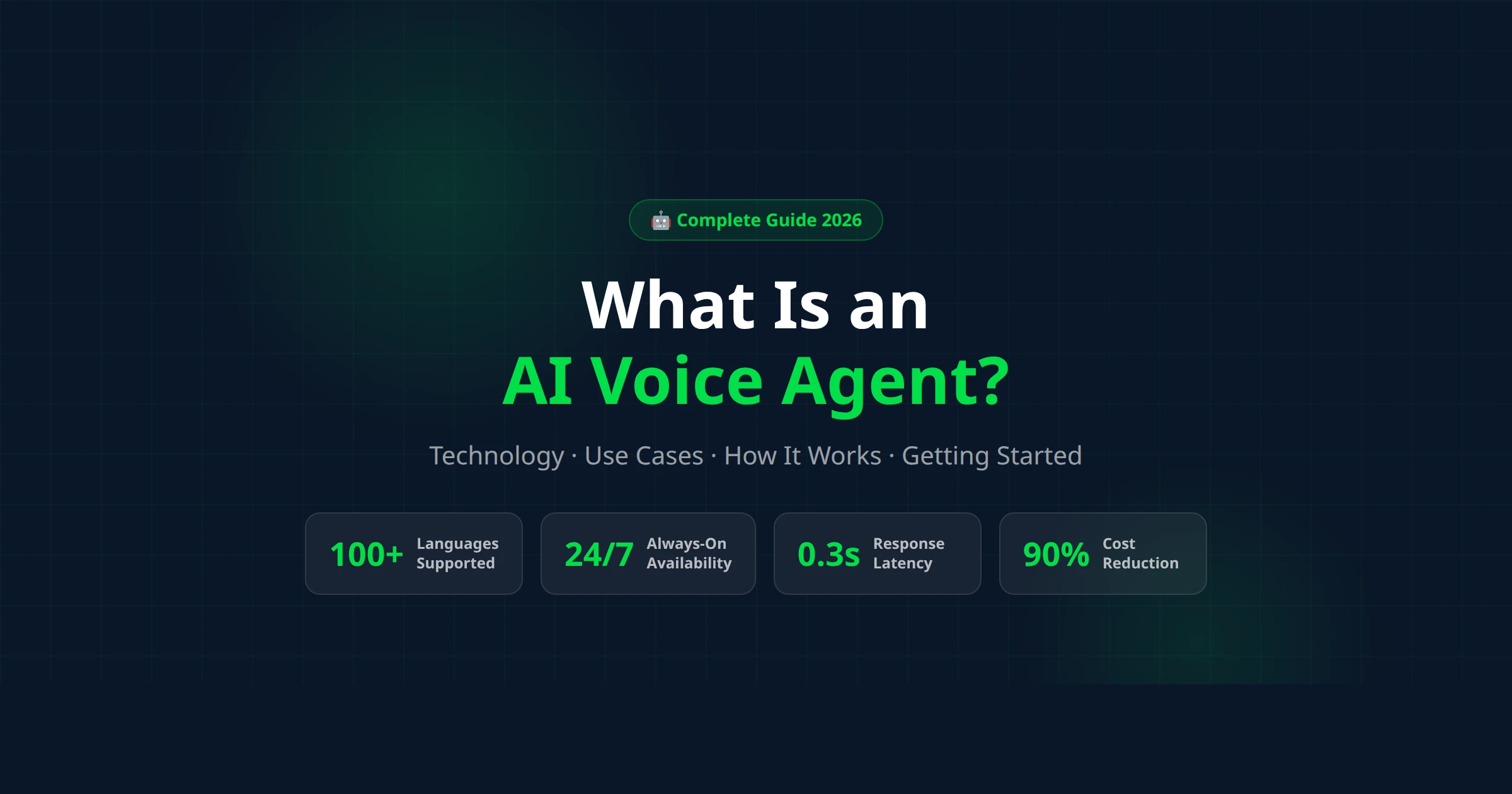
What Is an AI Voice Agent? Complete Guide 2026
AI voice agents are software systems that can make and receive phone calls autonomously — having natural, human-like conversations with callers using artificial intelligence. They're replacing IVR menus, voicemail, and even human call center agents for businesses of every size. This guide explains exactly how they work, what they can do, and how to get started.
What Is an AI Voice Agent?
An AI voice agent is an artificial intelligence system that conducts phone conversations autonomously. Unlike simple chatbots that handle text messages or IVR systems that play pre-recorded menus, AI voice agents:. best AI voice agent platforms
- Listen to what callers say using speech-to-text (STT) technology
- Understand the caller's intent using large language models (LLMs) like GPT-4
- Respond with natural-sounding speech using text-to-speech (TTS) engines like ElevenLabs
- Take action — book appointments, transfer calls, update records, send follow-ups
The result is a phone conversation that feels remarkably human. Callers can interrupt, ask follow-up questions, change topics, and the AI adapts in real-time — just like talking to a person.
💡 Simple definition
An AI voice agent is like a virtual employee that answers and makes phone calls for your business — 24/7, in 100+ languages, handling unlimited calls simultaneously. It's the modern replacement for voicemail, IVR menus, and human call center agents.
How AI Voice Agents Work: The 4-Step Loop
Every AI voice agent conversation follows the same real-time loop, happening in under 300 milliseconds per turn:
👂
Step 1: Listen
Speech-to-text converts the caller's words into text in real-time (Deepgram, Whisper)
🧠
Step 2: Think
LLM processes intent, context, and conversation history to generate a response (GPT-4, Claude)
🗣️
Step 3: Speak
Text-to-speech converts the response into natural-sounding voice (ElevenLabs, Cartesia)
⚡
Step 4: Act
Execute actions: book appointments, transfer calls, send SMS, update CRM records
This entire loop happens continuously throughout the conversation. The AI is simultaneously listening, processing, and preparing its next response — creating a natural back-and-forth dialogue that feels human.
The Interruption Challenge
The hardest technical problem in AI voice is handling interruptions. When a caller cuts in mid-sentence, the AI needs to immediately stop speaking, process the new input, and respond appropriately. Cheap implementations sound robotic because they can't handle this. Premium platforms like Autocalls use proprietary engines (like Dualplex™) specifically designed for natural interruption handling with sub-300ms response times.
AI Voice Agent vs. IVR vs. Chatbot vs. Virtual Assistant
| Feature | AI Voice Agent | IVR System | Chatbot | Virtual Assistant (Siri/Alexa) |
|---|---|---|---|---|
| Channel | Phone calls | Phone calls | Text/web | Smart speakers |
| Conversation style | Natural dialogue | "Press 1 for..." | Text exchanges | Command-response |
| Context awareness | Full conversation history | None | Limited | Session-based |
| Can take actions | Book, transfer, update CRM | Route calls | Limited | Smart home only |
| Handles interruptions | Yes (real-time) | No | N/A | Basic |
| Business-specific | Fully customizable | Limited menus | Varies | Consumer-focused |
Key insight: AI voice agents aren't just "better IVR" — they're a fundamentally different technology. IVR follows scripted menus. AI voice agents have conversations, understanding intent and adapting in real-time.
What Can AI Voice Agents Do?
Inbound Call Handling
- Answer calls 24/7 — no hold music, no voicemail, every call picked up instantly
- Answer FAQs — business hours, pricing, services, directions, policies
- Book appointments — check calendar availability and confirm in real-time
- Qualify leads — ask screening questions and score leads before transferring
- Route calls — transfer to the right department or person based on intent
- Handle complaints — acknowledge issues, log details, escalate when needed
- Take orders — process orders, reservations, or service requests
Outbound Calling
- Appointment reminders — reduce no-shows by 40–60%
- Follow-up calls — check on customer satisfaction, request reviews
- Lead qualification — call inbound leads within seconds of form submission
- Surveys — conduct customer satisfaction surveys at scale
- Payment reminders — friendly payment follow-ups with payment link via SMS
Multichannel Extensions
Modern AI voice agents don't stop at phone calls. Platforms like Autocalls extend the same AI to WhatsApp, website chat, and SMS — creating a unified omnichannel experience where the AI remembers context across all channels.
AI Voice Agent Use Cases by Industry
🏥 Healthcare
- Patient appointment scheduling
- Prescription refill requests
- Insurance verification
- After-hours triage routing
🏡 Real Estate
- Property inquiry handling
- Showing appointment scheduling
- Lead qualification and scoring
- After-hours lead capture
⚖️ Legal
- Client intake screening
- Consultation scheduling
- Case status updates
- After-hours emergency routing
🔧 Home Services
- Emergency service dispatch
- Appointment booking
- Quote requests
- Service status updates
🍕 Restaurants
- Reservation management
- Takeout order processing
- Menu inquiries and specials
- Hours and location info
📞 Call Centers
- Tier 1 support automation
- Call volume spike handling
- After-hours coverage
- Outbound campaign automation
The Technology Behind AI Voice Agents
| Layer | Technology | Key Providers | What It Does |
|---|---|---|---|
| Speech-to-Text (STT) | Automatic Speech Recognition | Deepgram, Whisper, Google STT | Converts caller's voice to text |
| Language Model (LLM) | Large Language Model | GPT-4o, Claude, Gemini | Understands intent, generates responses |
| Text-to-Speech (TTS) | Neural Voice Synthesis | ElevenLabs, Cartesia, Azure TTS | Generates natural-sounding voice |
| Telephony | VoIP / SIP | Twilio, Vonage, Telnyx | Handles phone call routing |
| Orchestration | Voice AI Platform | Autocalls, Vapi, Retell | Coordinates all layers in real-time |
The orchestration layer is what separates great AI voice from mediocre. It manages the timing between listening, thinking, and speaking — ensuring sub-300ms response times and natural conversation flow. This is why purpose-built platforms outperform DIY solutions assembled from individual APIs.
Benefits & Current Limitations
✅ Benefits
- 90% cost reduction vs. human agents ($34/mo vs. $3,000/mo)
- 24/7/365 availability — never misses a call
- Unlimited parallel calls — handles 500+ calls simultaneously
- 100+ languages — instant multilingual support
- Perfect consistency — same quality on call 1 and call 10,000
- Instant deployment — live in 15 minutes, not 2 weeks
- Zero training costs — no ramp-up period for new agents
- Real-time analytics — every call recorded, transcribed, analyzed
⚠️ Current Limitations (as of 2026)
- Complex empathy — handles most emotional situations but humans still better for crisis/grief
- Accents — heavy regional accents can reduce accuracy (improving rapidly)
- Creative problem-solving — follows scripts well, but novel edge cases may need human escalation
- Regulatory gray areas — disclosure laws vary by jurisdiction
- Background noise — accuracy drops in very noisy environments
The solution: Use AI for 80–90% of calls and route complex cases to humans. This hybrid approach gives you the cost savings of AI with the safety net of human backup.
How to Get Started with AI Voice Agents
Option 1: Use a No-Code Platform (Recommended)
The fastest way to deploy an AI voice agent. No programming needed — just describe what you want your agent to do, configure a few settings, and you're live.
- Sign up for a platform (e.g., Autocalls — starting at $34/mo)
- Create your AI agent using the guided wizard
- Set your business greeting, FAQ responses, and call routing rules
- Get a phone number or forward your existing number
- Test with a few calls and go live — total setup: 15 minutes
Option 2: Build with APIs (For Developers)
Assemble your own stack using individual APIs. Gives maximum control but requires ongoing development and maintenance:
- Choose your providers: STT (Deepgram), LLM (OpenAI), TTS (ElevenLabs), Telephony (Twilio)
- Build the orchestration layer (the hard part)
- Handle latency optimization, interruption detection, error handling
- Total cost: $0.12–$0.25/min + development time
Reality check: Building a production-quality AI voice agent from scratch takes 3–6 months of development. Most businesses are better served by a platform that's already solved the hard problems.
Top AI Voice Agent Platforms (2026)
| Platform | Best For | Price | Channels | White Label |
|---|---|---|---|---|
| Autocalls | All-in-one + agencies | From $34/mo | Voice+WA+Chat | ✅ Full |
| Synthflow | Developers | From $29/mo + BYOK | Voice | ✅ Partial |
| Vapi | API-first developers | $0.05/min + BYOK | Voice | API-level |
| Retell AI | Custom voice | Per-min + BYOK | Voice | API-level |
| Bland AI | Outbound at scale | $0.07/min | Voice | Enterprise |
For a detailed comparison, see our Best AI Answering Service 2026 guide.
The Future of AI Voice Agents
AI voice technology is evolving fast. Here's what's coming in 2026–2028:
- Emotion detection: AI will recognize caller emotions (frustration, urgency, confusion) and adapt its tone and approach in real-time
- Proactive calling: AI agents that initiate calls based on triggers — a missed appointment, an abandoned cart, a service due date
- Multimodal: Voice agents that can share screens, send images, or start video calls when voice isn't enough
- Agent-to-agent: Your AI calls another business's AI — negotiating appointments, comparing quotes, scheduling services
- Regulatory frameworks: Clear laws around AI disclosure, consent, and accountability in phone conversations
The businesses adopting AI voice agents today will have a significant competitive advantage over those waiting for the technology to "mature." The technology is already mature enough to handle 80–90% of business phone calls — the remaining 10–20% get routed to humans.


 5.0
5.0 5.0
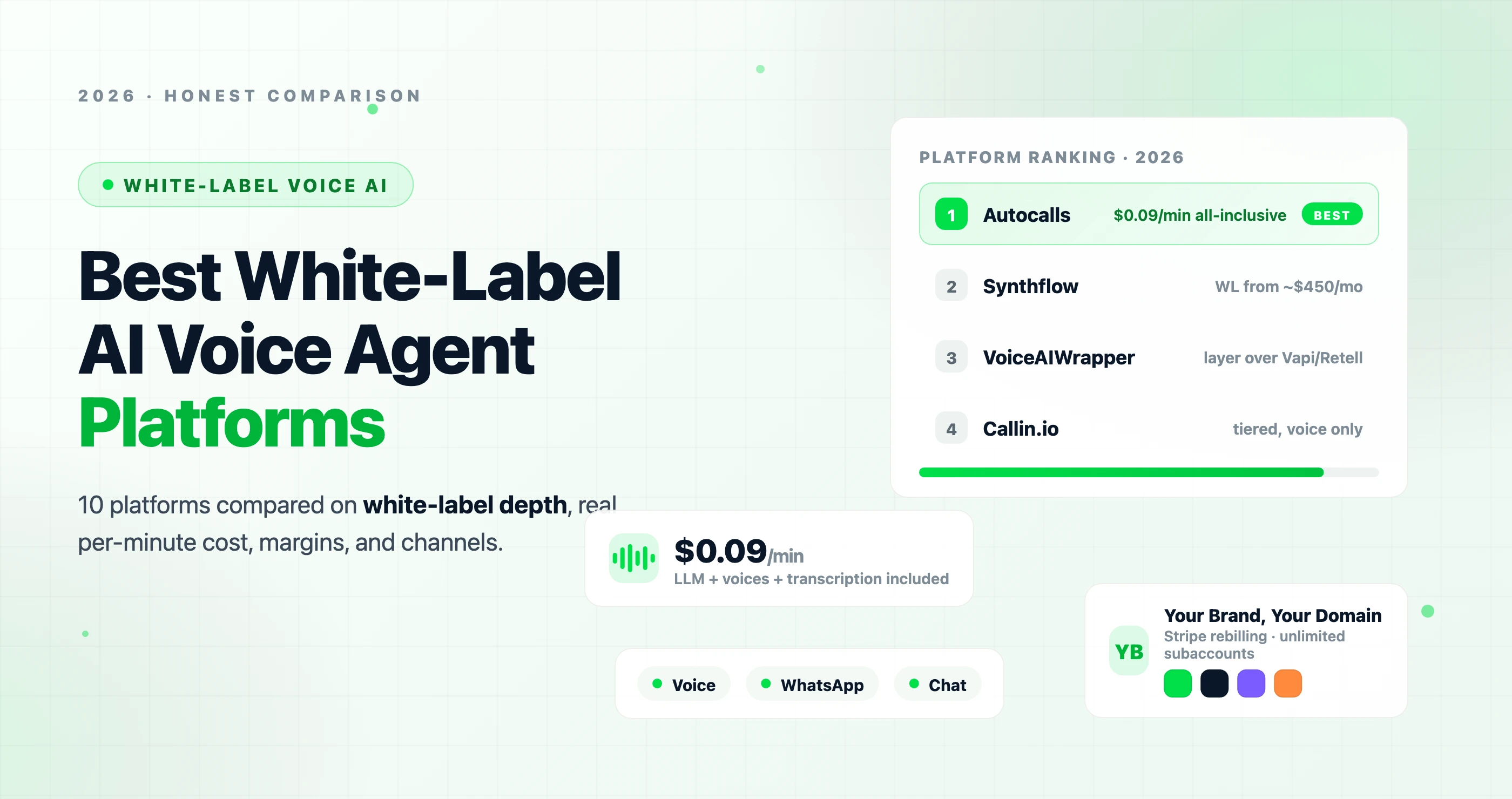
5.0Want to sell AI voice agents as your own product? We compared the 10 best white-label AI voice agent platforms on pricing, white-label depth, and agency margins: read the white-label comparison →