Updated June 2026.
White Label AI Voice Agent: Complete Agency Guide 2026
White-label AI voice agents let you resell a fully branded AI phone platform under your own company name — your logo, your domain, your pricing. This guide covers everything from choosing a platform to onboarding your first client, with real cost comparisons and margin calculations.
What Is a White-Label AI Voice Agent?
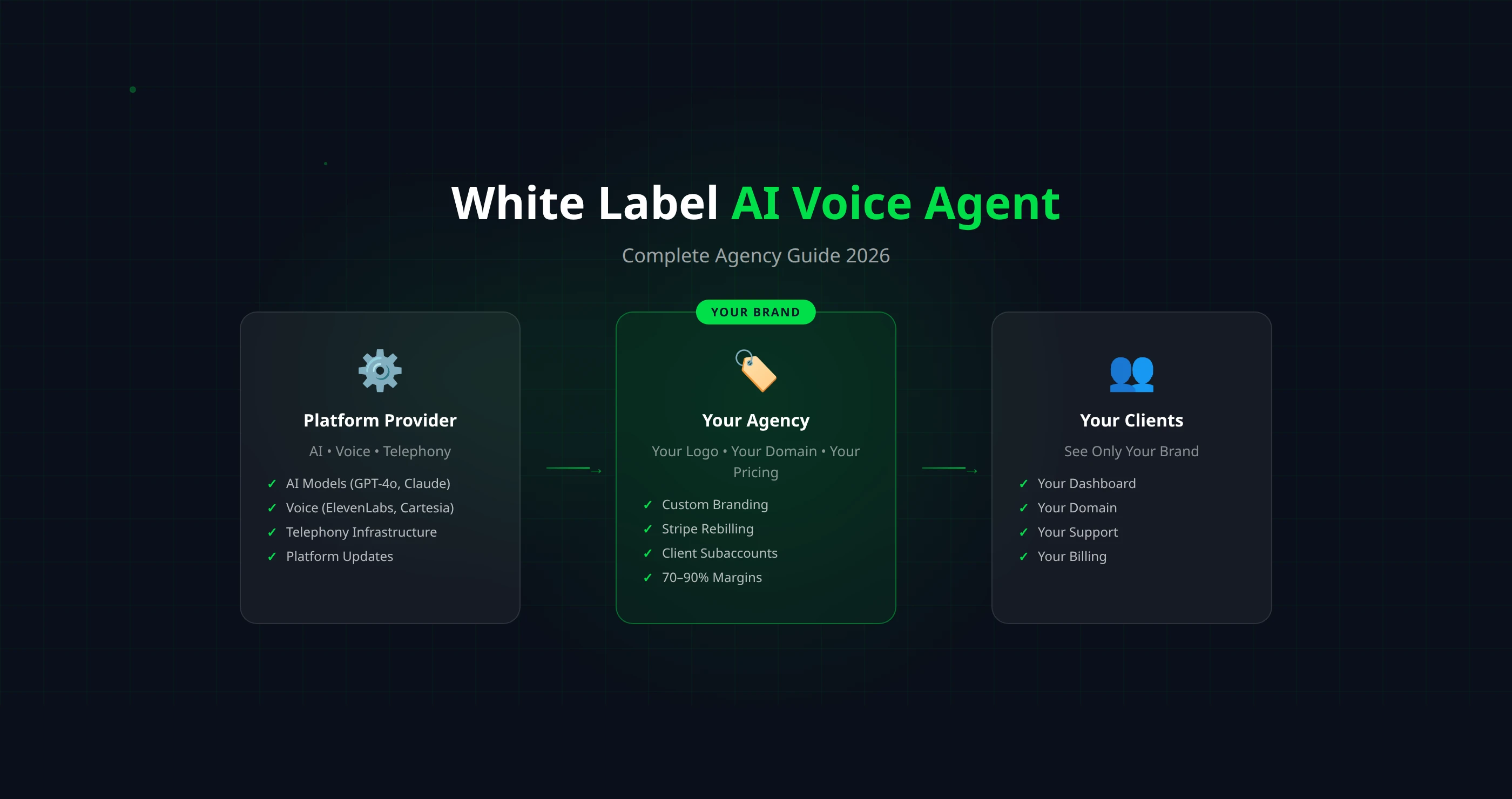
A white-label AI voice agent is an AI-powered phone system that you rebrand and resell as your own product. Your clients interact with your brand at every touchpoint — your dashboard, your domain, your logo — while the underlying technology is built and maintained by a platform provider.
Think of it like Shopify for AI phone calls. Shopify builds the commerce engine; you build a store on top of it and sell to your customers. With white-label AI voice agents, the platform handles the AI, telephony, speech recognition, and voice synthesis — you handle the client relationships, customization, and billing.
🏷️ What clients see
- Your company name and logo
- Your custom domain (e.g., calls.youragency.com)
- Your pricing plans and billing
- Your support email and documentation
⚙️ What the platform handles
- AI language models (GPT-4o, Claude, etc.)
- Voice synthesis (ElevenLabs, Cartesia)
- Speech recognition (Deepgram, Whisper)
- Telephony infrastructure and phone numbers
- Platform updates and maintenance
The result: you run an AI voice agent business without building any technology. Your clients get a world-class product. You keep the margin between what you pay the platform and what you charge your clients — typically 70–90%.
Why Agencies Are Switching to White-Label AI Voice Agents
The AI voice agent market is growing fast, and agencies are at the center of it. Here's why the white-label model is winning:
$4.2B
Projected AI call automation market by 2027 — up from $1.8B in 2024. Agencies that move now are positioning themselves for a 3–5 year growth curve.
85%
Average margin on white-label AI voice services. Compare that to 20–30% margins on traditional marketing agency work.
62%
Of small businesses miss calls regularly. That's your addressable market — every missed call is a pain point you can solve.
White-Label vs. Building Your Own
| White-Label Platform | Build from Scratch | |
|---|---|---|
| Time to launch | 24–48 hours | 3–6 months |
| Upfront cost | $419/mo | $50,000–$200,000+ |
| Engineering team needed | No | 3–5 engineers |
| Ongoing maintenance | Handled by platform | Your team, 24/7 |
| AI model updates | Automatic | Manual integration |
| Compliance (ISO, SOC 2) | Inherited from platform | $30K–$100K to obtain |
Unless you have a team of engineers and $200K+ to invest, building from scratch isn't viable. White-label lets you compete with well-funded platforms from day one — with none of the engineering overhead — voice agent platforms
How White-Label AI Voice Agents Work
The architecture behind a white-label AI voice agent has several layers, all invisible to your end clients:
Phone call comes in
A customer dials your client's phone number. The call routes through the telephony layer (SIP/PSTN) to the AI engine.
Speech-to-text transcription
The caller's voice is converted to text in real time using providers like Deepgram or OpenAI Whisper (sub-200ms latency).
AI processes and decides
A large language model (GPT-4o, Claude, etc.) processes the text against your client's custom prompt, tools, and business rules.
Text-to-speech response
The AI's reply is converted back to natural-sounding speech using voices from ElevenLabs, Cartesia, or OpenAI TTS.
Actions execute in real time
During the call, the AI can book appointments (Calendly, Cal.com, GoHighLevel), transfer to a human, send SMS, update a CRM, or trigger any webhook.
The entire round-trip — hear → transcribe → think → speak — takes under 800 milliseconds on modern platforms. Callers experience a natural conversation, not a laggy chatbot.
White-Label AI Voice Agent Platforms Compared (2026)
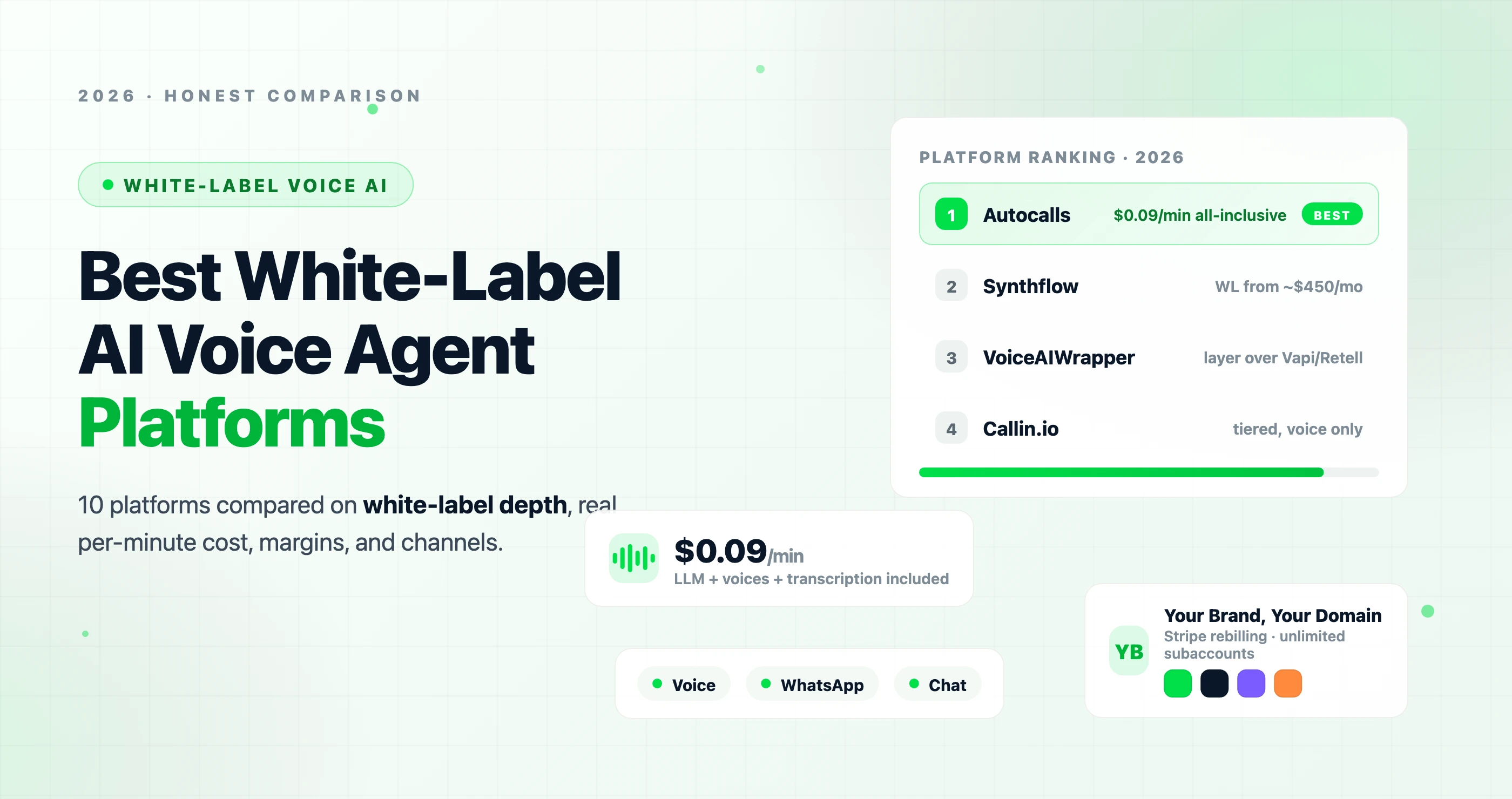
Not all white-label offerings are equal. Some platforms offer native white-label dashboards; others require third-party wrappers or partner programs. Here's how the major players compare:
| Platform | WL Type | Monthly Cost | Included Minutes | BYOK Required? | Channels | Subaccounts |
|---|---|---|---|---|---|---|
| Autocalls | Native first-party | $419/mo | 3,500 | No — all included | Voice + WhatsApp + Chat | Unlimited |
| Synthflow | Native first-party | $1,400/mo | 6,000 | Yes (TTS, LLM extra) | Voice only | Unlimited |
| Retell AI | Via partners (ChatDash, Knotie) | Custom | Per-minute | Yes (required) | Voice only | Via partner |
| Vapi | API-first (Vapify, VoiceAIWrapper) | Custom | Per-minute | Yes (required) | Voice only | Via partner |
| Bland AI | Enterprise subaccounts | $0.07–$0.14/min | Per-minute | Partial | Voice only | Yes (enterprise) |
💡 Key distinction: "all-inclusive" vs. BYOK pricing
When a platform says "$0.05/min" but requires BYOK (Bring Your Own Keys), you're also paying separately for ElevenLabs ($0.04–$0.10/min), an LLM ($0.01–$0.03/min), and a transcriber ($0.01/min). Real cost: $0.11–$0.19/min. All-inclusive platforms like Autocalls bundle everything at $0.09/min — no hidden costs, no API key management.
7 Things to Look for in a White-Label AI Voice Platform
1. Complete brand removal
The platform's name should appear nowhere — not in emails, not in dashboard footers, not in API responses, not in call metadata. Some platforms leave branding in subtle places (email headers, Twilio caller ID). Test thoroughly before committing.
2. Custom domain and SSL
Your clients should log in at app.youragency.com, not youragency.platformname.com. A proper white-label platform supports full custom domains with automated SSL certificate provisioning.
3. Subaccount management
You need the ability to create isolated client accounts, each with their own AI agents, phone numbers, call logs, and billing. Look for per-client usage tracking and the ability to set custom limits per subaccount.
4. Flexible billing and rebilling
The best platforms include Stripe integration for automated client billing. You set your own pricing tiers, the platform handles metering and invoicing under your brand. If a platform doesn't support native rebilling, you'll spend hours each month manually calculating usage and sending invoices.
5. Multichannel capabilities
Voice-only platforms are already behind. In 2026, clients expect AI that handles phone calls and WhatsApp messages and website chat. Offering all three from one dashboard lets you charge more and makes your service much harder to replace.
6. Security certifications
If you plan to sell to healthcare, legal, or financial services clients, you need HIPAA/GDPR compliance. Platforms with ISO 27001 or SOC 2 certification give you that credibility out of the box — without spending $30K–$100K getting certified yourself.
7. API access for custom integrations
Even if you start no-code, you'll eventually need API access for custom workflows — syncing with GoHighLevel, pushing call data to a CRM, triggering automations. Choose a platform with a well-documented REST API and webhook support.
The Economics: Real Costs, Margins, and Pricing Strategy
The financial case for white-label AI voice agents is compelling — but only if you understand the real numbers. Here's a breakdown using actual platform pricing:
Your Costs (Platform Side)
| Cost Component | All-Inclusive Platform | BYOK Platform |
|---|---|---|
| Platform subscription | $419/mo (includes 3,500 min) | $1,400/mo (includes 6,000 min) |
| TTS (ElevenLabs) | Included | $0.04–$0.10/min extra |
| LLM (GPT-4o / Claude) | Included | $0.01–$0.03/min extra |
| STT (Deepgram) | Included | $0.01/min extra |
| Phone numbers | From $3.99/number | $1–$5/number (Twilio) |
| Effective cost/min (after included) | $0.09/min overage | $0.13–$0.25/min total |
Revenue (What You Charge Clients)
Based on what successful white-label AI voice agencies actually charge:
| Your Plan Name | You Charge | Your Cost | Gross Margin |
|---|---|---|---|
| Starter (AI receptionist, 100 calls/mo) | $149/mo | ~$15–25 | 83–90% |
| Professional (24/7 AI, 300 calls/mo) | $299/mo | ~$35–60 | 80–88% |
| Enterprise (+ WhatsApp + outbound) | $499/mo | ~$50–90 | 82–90% |
Example: 20 Clients on All-Inclusive Platform
Monthly Revenue
$5,980
20 clients × $299 avg
Platform Cost
$499
$419 + $80 phone numbers
Monthly Profit
$5,481
91.6% margin
Setup: From Sign-Up to First Client in 48 Hours
Here's the actual step-by-step process to go live with a white-label AI voice agent platform:
Day 1: Platform Setup (2–3 hours)
- Sign up for a white-label plan — you'll get an admin dashboard within minutes
- Configure your branding: Upload your logo, set your brand colors, connect your custom domain
- Set up Stripe: Connect your Stripe account for automated client billing. Create your pricing tiers (Starter, Pro, Enterprise)
- Customize client-facing pages: Login page, signup flow, dashboard elements, email templates
- Purchase your first phone numbers: Get a few local numbers in your target market
Day 1–2: Build Your Demo Agent (1–2 hours)
- Create a sample AI assistant for your target niche (e.g., dental practice receptionist)
- Write a system prompt covering: greeting, business hours, appointment booking, FAQ handling, call transfer rules
- Choose a voice from ElevenLabs or Cartesia that fits the brand (professional, warm, natural)
- Connect tools: Calendly for scheduling, webhook for CRM updates
- Test with 5–10 calls — adjust the prompt until conversations flow naturally
Day 2: Launch and Prospect (2–4 hours)
- Record a demo video showing a real call with your AI agent
- Create a one-page website or landing page for your agency
- Start outreach: Call 20 local businesses at 6 PM — the ones that go to voicemail are your prospects
- Send personalized emails with your demo recording and a link to try your AI receptionist
⚡ Speed matters
The biggest advantage of white-label over building custom: you can go from zero to a live demo agent in a single day. Clients don't care about your tech stack — they care about hearing a professional AI answer their phone. Get a demo running and start selling before you overthink it.
Top Use Cases for White-Label AI Voice Agents
White-label AI voice agents work across dozens of industries. Here are the highest-converting use cases that successful agencies are deploying:
📞 AI Receptionist (Inbound)
Answer every call 24/7, collect caller information, answer FAQs, and route urgent calls to humans. Perfect for dental offices, law firms, and medical practices. Replaces $35K/year human receptionists with $149–$299/month AI.
📅 Appointment Scheduling
AI books appointments directly into Calendly, Cal.com, or GoHighLevel during the call. No back-and-forth emails, no manual data entry. Average conversion: 40–60% of inbound calls booked automatically.
📊 Lead Qualification (Outbound)
AI calls leads from a list, qualifies them with 3–5 screening questions, and transfers hot leads to the sales team. Agencies use this for real estate, insurance, and B2B services. One agent can handle 500+ calls/day.
💬 Omnichannel Support
Combine voice AI with WhatsApp and website chat for a unified customer experience. Clients that offer all three channels have 2.5× higher retention than voice-only.
🔄 After-Hours Coverage
Many businesses only need AI during evenings, weekends, and holidays — when human staff aren't available. This is an easy sell because the ROI is immediate: capture calls that would otherwise go to voicemail and never be returned.
💳 Payment Collection
AI agents handle payment reminders and collection calls for debt collection, medical billing, and subscription renewals. Sensitive enough to require FDCPA/GDPR compliance — a reason to charge premium pricing.
5 Costly Mistakes to Avoid with White-Label AI Voice Agents
❌ Choosing a platform based on per-minute price alone
A platform advertising "$0.05/min" but requiring BYOK will cost you $0.15–$0.25/min in reality. Always calculate the total cost per minute including all providers (TTS, LLM, STT, telephony) before comparing.
❌ Choosing a voice-only platform in 2026
WhatsApp has 2 billion users. Website chat is expected on every business site. If your platform only handles phone calls, you're limiting your addressable market and giving clients a reason to look elsewhere for their other channels.
❌ Skipping the demo agent
The #1 sales tool is letting prospects call your AI and experience it live. Agencies that skip building a polished demo agent close 3–5× fewer deals. Build one great demo for your target niche before doing any outreach.
❌ Not verifying white-label completeness
Some platforms claim "white label" but leak the vendor name in email headers, API error messages, Twilio SMS sender IDs, or dashboard footer text. Test every client touchpoint before going live. One leaked brand name destroys the illusion.
❌ Ignoring compliance for regulated industries
Healthcare (HIPAA), legal (attorney-client privilege), and financial services (PCI-DSS) all have strict data handling requirements. If you sell to these verticals, your platform must be certified. Choosing a platform with ISO 27001 certification saves you from a compliance nightmare later.

 5.0
5.0 5.0
5.0Want the platform-by-platform breakdown? We compared the 10 best white-label AI voice agent platforms on pricing, white-label depth, and agency margins: read the white-label comparison →
Frequently Asked Questions
Turn what you just learned into a business
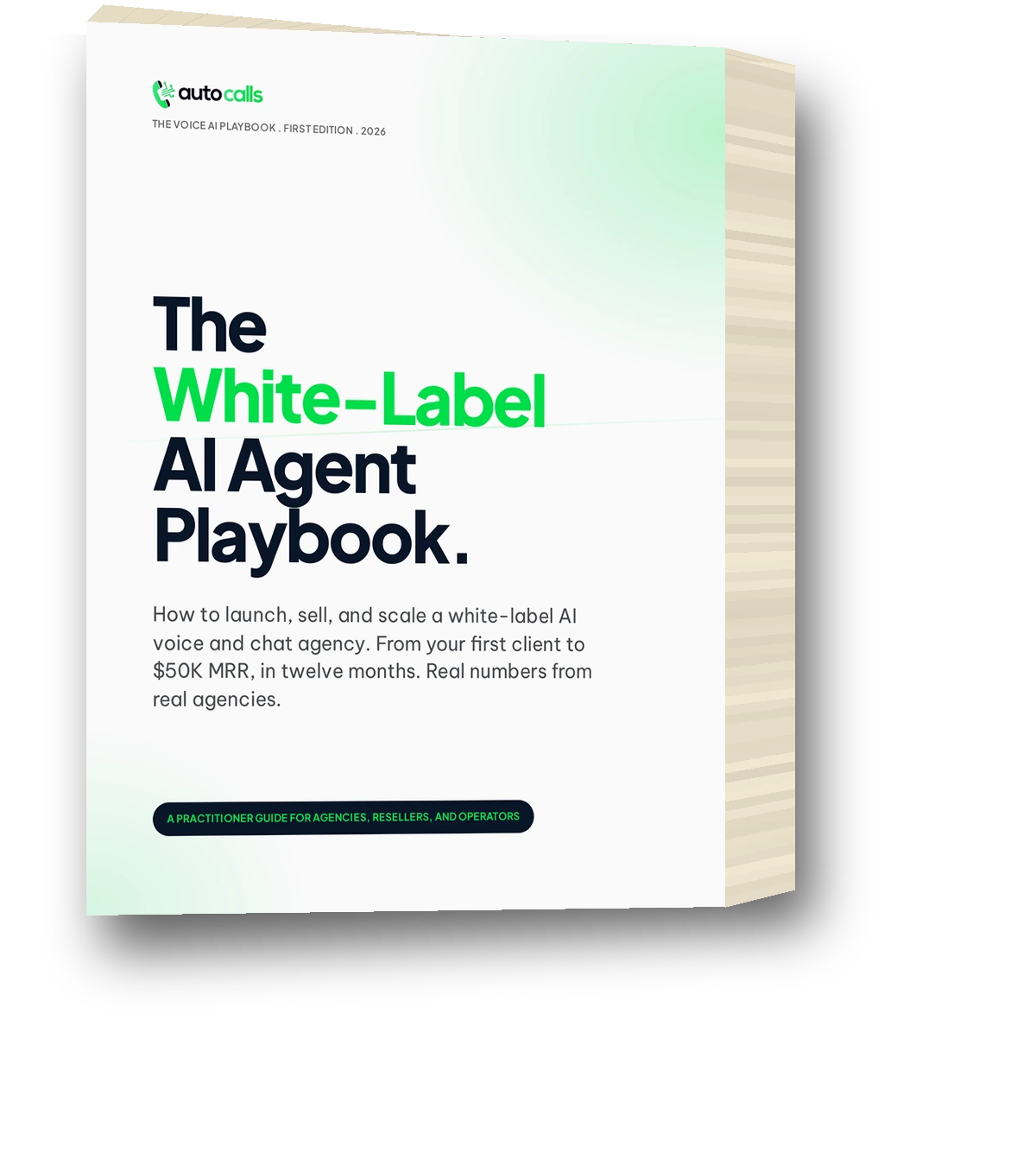
The Voice AI Playbook: 156 pages on launching a white-label voice AI agency, from picking a niche to landing your first 3 clients. It ships with a 20-slide customer pitch deck you can rebrand and present as your own (PowerPoint + PDF + rebrand guide). Free, delivered by email.