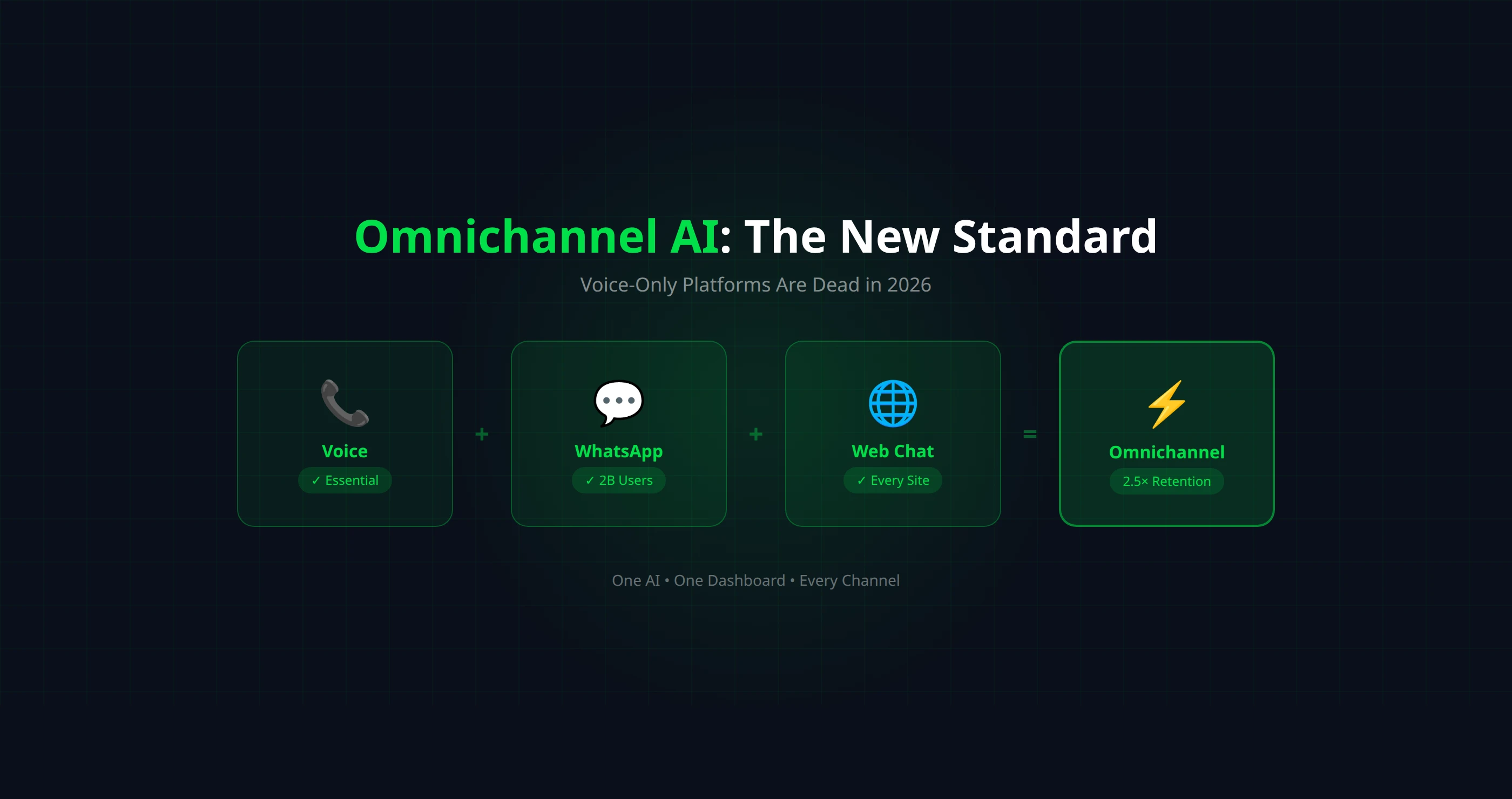
Omnichannel AI: Why Voice-Only Platforms Are Dead in 2026
Your customers don't live on one channel. They call you, WhatsApp you, message your website, and expect the same experience everywhere. Voice-only AI platforms are becoming obsolete. This guide explains why omnichannel AI is the new standard, how it works, and what to look for in a platform.
The Problem with Single-Channel AI
Most AI voice agent platforms — Vapi, Retell AI, Bland AI, Synthflow — do one thing well: phone calls. But customer communication in 2026 doesn't happen on just one channel:
2B+
WhatsApp monthly active users — your customers are already there
73%
of consumers use multiple channels during a single customer journey
2.5×
higher customer retention for businesses offering omnichannel vs. single-channel support
When you use a voice-only AI platform, you're solving phone calls but leaving gaps everywhere else. A customer WhatsApps you at 9 PM — no response. They visit your website at 11 PM — no chat. They call during lunch — AI handles it perfectly. That inconsistency is worse than having no AI at all because it creates an uneven experience.
The solution isn't buying three separate tools (a voice AI, a WhatsApp bot, and a website chatbot). That creates data silos, inconsistent responses, and triple the management overhead. The solution is one AI platform that handles all channels from a single dashboard.
What Is Omnichannel AI?
Omnichannel AI means a single AI agent that communicates with customers across multiple channels — phone calls, WhatsApp, website chat, SMS — with shared context. The AI knows the customer's history regardless of which channel they use.
💡 Example: Omnichannel in action
A patient WhatsApps your dental practice: "Do you have any openings next week?" The AI responds with available slots. The patient says "I'll think about it." Two days later, the patient calls. The AI recognizes the number: "Hi! I see you were looking at appointment slots last week. Would you like to book one of those?" That's omnichannel — one AI, shared context, seamless experience.
Omnichannel vs. Multichannel — What's the Difference?
❌ Multichannel (disconnected)
Separate tools for each channel. Phone AI doesn't know about WhatsApp conversations. Customer repeats themselves on every channel. Different response quality per channel. Three dashboards to manage.
✅ Omnichannel (unified)
One AI agent across all channels. Shared customer context and history. Consistent responses everywhere. Single dashboard for management. One prompt to maintain instead of three.
The Three Channels That Matter in 2026
📞 Voice (Phone Calls)
Still the #1 channel for high-value interactions — emergencies, complex questions, and customers who prefer talking over typing. AI voice agents handle inbound and outbound calls with natural conversation.
Best for: Appointments, emergencies, complex support, sales calls, older demographics
2 billion users worldwide. In many markets (Latin America, Europe, Asia, Middle East), WhatsApp is the primary way customers contact businesses. AI WhatsApp agents handle text, voice messages, images, and documents.
Best for: Quick questions, appointment confirmations, follow-ups, document sharing, younger demographics
🌐 Website Chat
Every visitor on your website is a potential lead. A chat widget powered by AI can answer questions, qualify leads, and book appointments — converting visitors who would otherwise bounce.
Best for: Lead capture, instant FAQ answers, product questions, conversion optimization
The businesses winning in 2026 aren't choosing between these channels — they're covering all three with a single AI platform. Each channel captures customers the others miss.
5 Benefits of Omnichannel AI over Voice-Only
Capture 100% of customer touchpoints
Voice-only means you miss WhatsApp messages and website visitors. Omnichannel catches every interaction — the 11 PM WhatsApp message, the 6 AM website question, the 2 PM phone call — all handled by one AI.
Higher customer satisfaction (CSAT)
Customers can reach you on their preferred channel. Some hate calling. Some hate typing. Give them options and they're happier. Research shows omnichannel support drives 2.5× higher retention.
One prompt, one dashboard, one bill
Managing separate tools for voice, WhatsApp, and chat means three prompts to maintain, three dashboards to monitor, and three invoices to pay. Omnichannel = one of each. 3× less management overhead.
Charge more (for agencies)
If you resell AI voice agents, offering voice + WhatsApp + chat justifies $299–$499/month pricing vs. $149/month for voice-only. It also makes your service stickier — clients are less likely to churn when you handle three channels.
Shared context = smarter AI
When the AI knows a customer's full interaction history (calls + messages + chats), it gives better responses. No more "Can you repeat what you told us on WhatsApp?" moments. The AI already knows.
Omnichannel AI Platform Comparison (2026)
Here's how major AI voice platforms stack up on channel support:
| Platform | Voice | Web Chat | Shared Context | Single Dashboard | |
|---|---|---|---|---|---|
| Autocalls | ✅ | ✅ | ✅ | ✅ | ✅ |
| Synthflow | ✅ | ❌ | ❌ | — | — |
| Vapi | ✅ | ❌ | ❌ | — | — |
| Retell AI | ✅ | ❌ | ❌ | — | — |
| Bland AI | ✅ | ❌ | ❌ | — | — |
The pattern is clear: most AI voice platforms are exactly that — voice platforms. Autocalls is currently the only major player offering true omnichannel (voice + WhatsApp + chat) from a single unified platform with shared context. If omnichannel matters for your business or agency, this is a key differentiator to evaluate.
How to Implement Omnichannel AI
Deploying omnichannel AI is simpler than it sounds when your platform supports all channels natively:
Phase 1: Start with voice (Week 1)
Set up your AI voice agent first — it's the most impactful channel. Get the system prompt right, test with real calls, and confirm the AI handles your use case well.
Phase 2: Add WhatsApp (Week 2)
Connect your WhatsApp Business number to the same AI. The prompt is already written — you just extend it to handle text-based interactions. Add your WhatsApp number to your website, business cards, and Google Business Profile.
Phase 3: Deploy website chat (Week 3)
Embed the chat widget on your website. Same AI, same knowledge base, new channel. Now every website visitor can get instant answers and book appointments without picking up the phone.
Total time from single-channel to fully omnichannel: 2–3 weeks with a platform that supports all channels natively. If you're using separate tools, expect 2–3 months and ongoing integration headaches.

 5.0
5.0 5.0
5.0