AI Dental Receptionist: Automate Patient Calls in 2026
Dental practices miss 30–40% of incoming calls during busy hours — and 67% of those callers never call back. An AI dental receptionist answers every call instantly, books appointments, verifies insurance, and handles patient questions 24/7 — for a fraction of the cost of a human front desk.
The Missed Call Problem in Dentistry
Dental practices depend on phone calls. Patients call to book cleanings, ask about insurance, confirm appointments, and request emergency slots. But most practices face the same problem:
35%
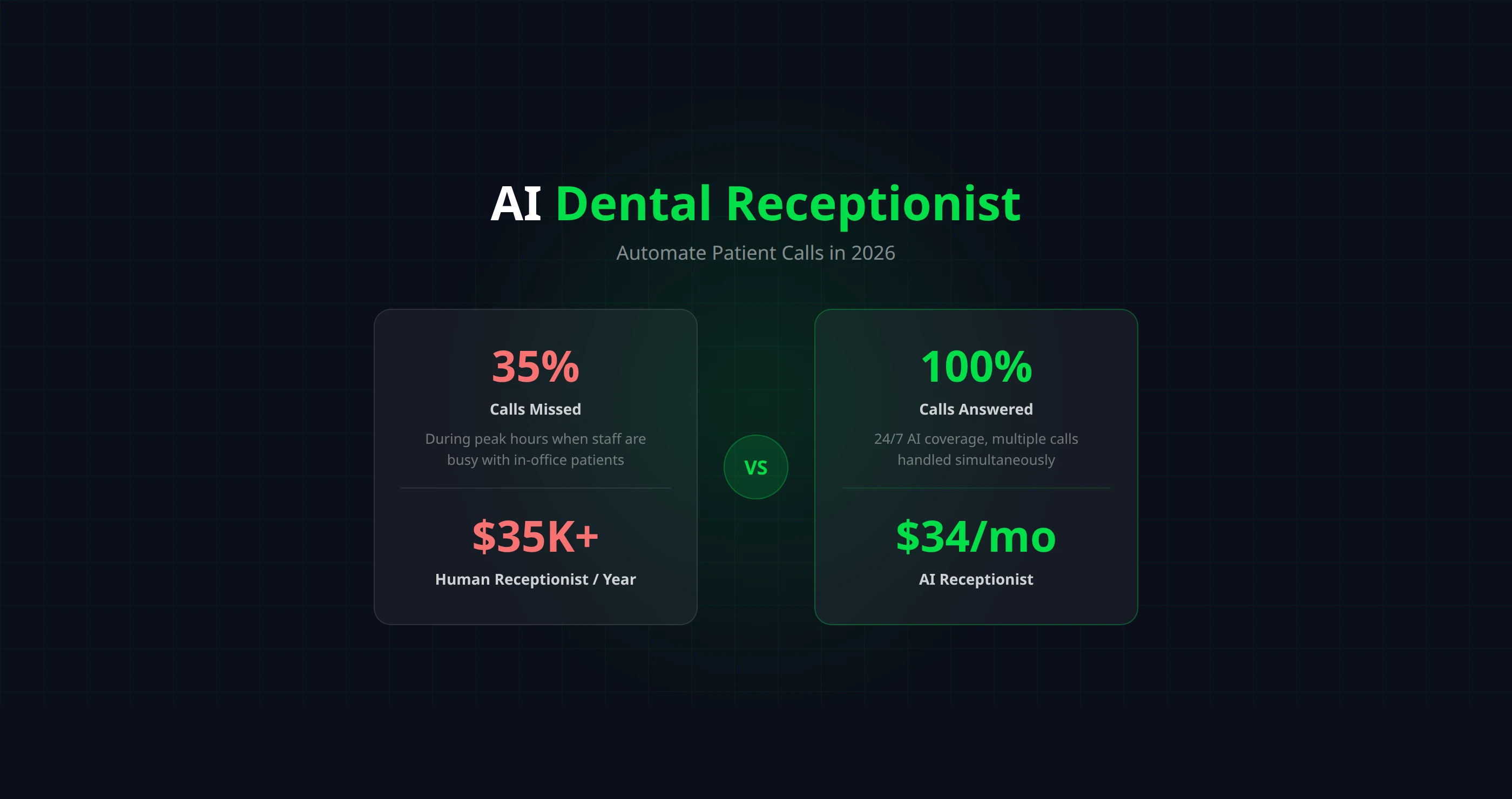
of calls go unanswered during peak hours when staff are helping patients in-office
67%
of callers who reach voicemail never call back — they book with a competitor instead
$200–$500
average value of a new dental patient — every missed call is hundreds in lost revenue
$35K+
annual cost of a full-time front desk receptionist (salary + benefits + training)
The front desk is a bottleneck. When the receptionist is checking in a patient, answering insurance questions in person, or processing paperwork, the phone rings — and rings — and goes to voicemail. Hiring a second receptionist doubles your cost. An AI receptionist costs 1–2% of that — AI answering service
What Is an AI Dental Receptionist?
An AI dental receptionist is a voice AI agent specifically configured for dental practices. It answers phone calls with a natural-sounding voice, understands what the caller needs, and takes action — booking appointments, answering questions, and collecting information — just like a trained human receptionist.
The difference: it answers every call instantly, works 24 hours a day, handles multiple calls simultaneously, and costs $50–$300/month instead of $35,000+/year.
💡 How it works in practice
A patient calls your practice at 7 PM (office closed). The AI answers: "Hi, thank you for calling Riverside Dental. I'm the automated assistant. How can I help you today?" The patient says they need a cleaning. The AI checks the schedule, offers available slots, confirms the booking, and sends a confirmation text — all in under 2 minutes. Next morning, your front desk sees the appointment already in the calendar.
What an AI Dental Receptionist Can (and Can't) Do
✅ What it handles well
Appointment scheduling
Books cleanings, exams, consultations directly into Calendly, Cal.com, or your PMS via API integration
Insurance questions
"Do you accept Delta Dental?" — AI answers from your configured list of accepted insurance providers
Office hours and directions
Answers location, parking, hours questions — the #1 most common call type for dental offices
Appointment reminders (outbound)
Calls patients to confirm upcoming appointments, reducing no-shows by 30–50%
New patient intake
Collects name, date of birth, insurance info, reason for visit — sends it to staff before the appointment
Emergency triage
Asks screening questions ("Are you in pain? Is there swelling?") and routes urgent cases to the dentist's cell
❌ What still needs a human
Complex insurance verification
Calling insurance companies, verifying benefits, negotiating coverage — this still requires a trained billing coordinator
Treatment plan discussions
Explaining crown vs. bridge options, discussing costs for elective procedures — these need clinical knowledge and empathy
Anxious or upset patients
Dental anxiety is real. Patients who need reassurance and emotional support should be transferred to a human
Billing disputes
Patients questioning charges, negotiating payment plans, or disputing bills need human judgment and authority
The sweet spot: AI handles the 60–70% of calls that are routine (scheduling, FAQs, reminders, intake) and transfers the rest to your front desk staff. Your human receptionist stops being overwhelmed with phone calls and focuses on in-office patient experience.
ROI: The Real Numbers for a Dental Practice
Let's run the math for a typical dental practice with 80–120 calls per week:
| Metric | Without AI | With AI Receptionist |
|---|---|---|
| Calls answered | 65% (staff busy) | 100% (AI + staff) |
| After-hours coverage | Voicemail | Live AI 24/7 |
| Missed calls/week | 30–40 | 0–5 |
| New patients booked/month | 15–20 | 22–30 (+40%) |
| No-show rate | 15–20% | 8–12% (AI reminders) |
| Monthly cost | $2,900+ (receptionist) | $149–$299 (AI) |
💰 Conservative ROI estimate
If AI captures just 5 extra new patients per month that would have gone to voicemail, at an average patient value of $300, that's $1,500/month in recovered revenue — for a $149–$299/month investment. That's a 5–10× ROI before counting reduced no-shows and freed-up staff time.
Best AI Dental Receptionist Platforms (2026)
Several platforms offer AI receptionist capabilities suitable for dental practices. Here's how they compare:
| Platform | Starting Price | Dental-Specific? | Scheduling | Channels | Compliance |
|---|---|---|---|---|---|
| Autocalls | $34/mo | Configurable for any niche | Calendly, Cal.com, GHL, API | Voice + WhatsApp + Chat | ISO 27001 ✅ |
| Dentina.ai | Custom | Dental-only | PMS integration | Voice + SMS | HIPAA ✅ |
| Synthflow | $29/mo + BYOK | General (configurable) | Calendly, Cal.com | Voice only | SOC 2 |
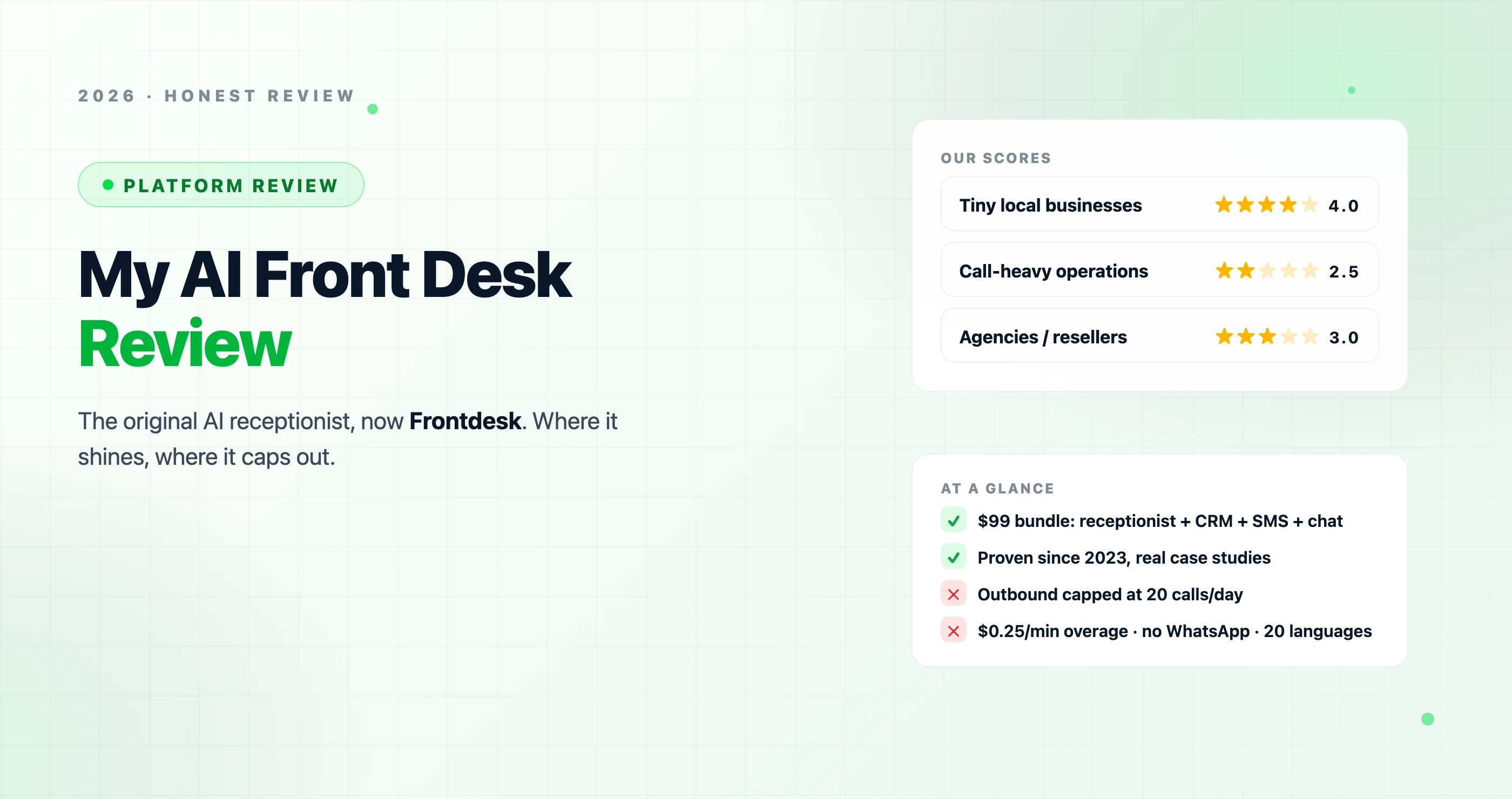
| My AI Front Desk | $65/mo | General (configurable) | Calendly | Voice + SMS | — |
Key considerations for dental practices:
- PMS integration: Can the AI connect to your practice management software (Dentrix, Eaglesoft, Open Dental)? Direct integration is ideal but API/webhook connections work too.
- Multichannel: Patients increasingly use WhatsApp and website chat alongside phone calls. Platforms that handle all three from one dashboard save you from managing multiple tools.
- Compliance: If you handle patient health information, ensure the platform has HIPAA-relevant security certifications (ISO 27001, SOC 2, or explicit HIPAA compliance).
For a detailed cost breakdown across all major platforms, see our AI voice agent pricing comparison.
How to Set Up an AI Dental Receptionist
Setting up an AI receptionist for your dental practice takes 1–2 hours with a no-code platform. Here's the step-by-step process:
Create your AI assistant
Sign up on your chosen platform and create a new AI assistant. Name it (e.g., "Riverside Dental Receptionist") and set it to handle inbound calls.
Write your system prompt
This is the AI's "brain." Include: practice name, address, hours, services offered, accepted insurance providers, booking rules (e.g., "new patients need 60-minute slots"), emergency protocols, and transfer rules.
Connect scheduling
Integrate with Calendly, Cal.com, or GoHighLevel for real-time appointment booking. The AI checks available slots and books directly — no double-booking risk.
Choose a voice
Select a professional, warm voice that matches your practice's vibe. Most platforms offer 50+ voices from providers like ElevenLabs and Cartesia. Test a few with sample calls.
Set up call forwarding
Either get a new number or forward your existing practice number to the AI. Options: AI answers all calls, AI answers only after 3 rings (overflow), or AI handles after-hours only.
Test and go live
Make 5–10 test calls simulating common patient scenarios. Adjust the prompt until conversations flow naturally. Then go live — start with after-hours only if you want to ease into it.
For a complete tutorial on building an AI voice agent without code, see our guide: Can AI Make Phone Calls?
HIPAA and Compliance Considerations
Dental practices handle protected health information (PHI), which means HIPAA compliance matters when deploying AI. Here's what to know:
Data handling
The AI will hear patient names, dates of birth, and appointment details. Ensure your platform encrypts call recordings, transcripts, and stored data at rest and in transit. Look for AES-256 encryption and TLS 1.3.
Business Associate Agreement (BAA)
Under HIPAA, any vendor handling PHI must sign a BAA with your practice. Ask your AI platform provider if they offer a BAA. Platforms with ISO 27001 or SOC 2 certifications are better positioned for this.
Call recording storage
Decide whether to enable call recording (useful for QA) or disable it (simpler compliance). If enabled, ensure recordings are stored in HIPAA-compliant infrastructure with access controls and automatic deletion policies.
Disclosure to patients
Best practice: have the AI identify itself as an automated assistant at the start of every call. Most states require disclosure of call recording. Transparency builds trust and protects you legally.
Bottom line: An AI dental receptionist can be HIPAA-compliant, but you need to choose a platform with appropriate security certifications and data handling practices. Don't assume compliance — verify it.
AI vs. Human Dental Receptionist: Honest Comparison
| AI Receptionist | Human Receptionist | |
|---|---|---|
| Availability | 24/7/365 | 40 hrs/week (with breaks, sick days, vacation) |
| Simultaneous calls | Unlimited | 1 at a time |
| Monthly cost | $34–$299 | $2,500–$4,500 |
| Consistency | Perfect (same quality every call) | Varies (mood, energy, training) |
| Empathy | Basic (script-driven) | Genuine emotional intelligence |
| Complex problem-solving | Limited to trained scenarios | Creative, adaptive |
| In-office tasks | Phone only | Check-in, paperwork, payments |
| Training time | 1–2 hours (prompt writing) | 2–4 weeks |
The best approach for most practices: AI + human working together. The AI handles phone calls (especially overflow and after-hours), freeing your human receptionist to focus on the in-office patient experience — check-ins, insurance coordination, and the warm personal touch that makes patients feel welcome. It's not AI or human. It's AI and human, each doing what they're best at.
For a deeper look at this dynamic, read: Will AI Replace Call Center Agents?

 5.0
5.0 5.0
5.0