Connect AssemblyAI with Autocalls.ai AI voice agents
Turn every call into searchable data with AssemblyAI and AI voice agents. Transcribe conversations, extract insights, and trigger faster follow-up automatically.
Connect AssemblyAI to your AI voice workflows to transcribe every inbound and outbound conversation, search key phrases, and pull structured insights from real calls.
Use those insights to improve appointment booking flows and strengthen your AI call center automation with cleaner call data.
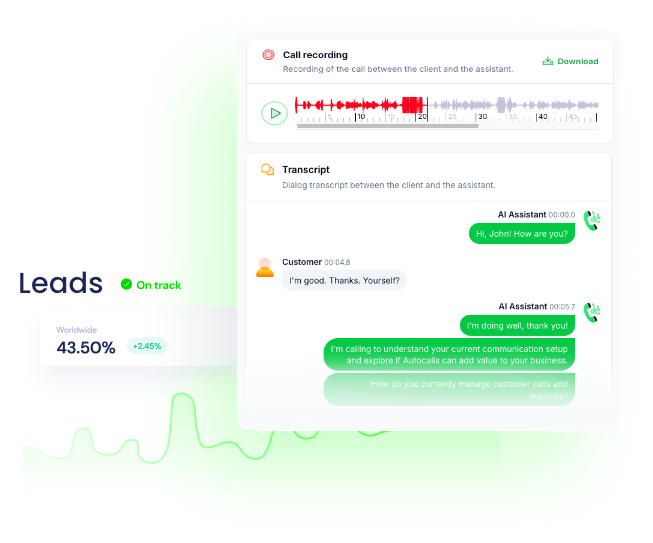
After a call ends, AssemblyAI can transcribe the audio, return paragraphs or sentences, and feed the result into your outreach logic for faster next steps.
This helps teams run better call automation for sales, support, and AI cold calling while giving agents context inside your integrations stack.
Use AssemblyAI actions like transcript search, subtitles, redacted audio, and LeMUR tasks to organize conversations and extract the details that matter most.
That gives your team better quality control for an AI answering service and more context for every AI virtual receptionist interaction.
Get a hands-on experience by trying a free demo call. Fill in your details, and our AI representative will call you instantly.
Try now a free AI call✓ No credit card required ✓ No commitment
Powerful actions you can trigger with AssemblyAI to automate your workflows
Use the LeMUR task endpoint to input your own LLM prompt.
Your text to prompt the model to produce a desired output, including any context you want to pass into the model.
Context to provide the model. This can be a string or a free-form JSON value.
Custom formatted transcript data. Maximum size is the context limit of the selected model, which defaults to 100000. Use either transcript_ids or input_text as input into LeMUR.
The model that is used for the final prompt after compression is performed.
The temperature to use for the model. Higher values result in answers that are more creative, lower values are more conservative. Can be any value between 0.0 and 1.0 inclusive.
A list of completed transcripts with text. Up to a maximum of 100 files or 100 hours, whichever is lower. Use either transcript_ids or input_text as input into LeMUR.
Max output size in tokens, up to 4000
Transcribe an audio or video file using AssemblyAI.
The list of custom topics
The URL of the audio or video file to transcribe.
Enable Automatic Punctuation, can be true or false
Redact PII from the transcribed text using the Redact PII model, can be true or false
The list of custom vocabulary to boost transcription probability for
How much to boost specified words
Enable Text Formatting, can be true or false
The URL to which we send webhook requests. We sends two different types of webhook requests. One request when a transcript is completed or failed, and one request when the redacted audio is ready if redact_pii_audio is enabled.
The point in time, in milliseconds, to stop transcribing in your media file
Transcribe Filler Words, like "umm", in your media file; can be true or false
Enable [Dual Channel](https://www.assemblyai.com/docs/models/speech-recognition#dual-channel-transcription) transcription, can be true or false.
The speech model to use for the transcription. When `null`, the "best" model is used.
The type of summary
Enable [Auto Chapters](https://www.assemblyai.com/docs/models/auto-chapters), can be true or false
Enable custom topics, either true or false
The language of your audio file. Possible values are found in [Supported Languages](https://www.assemblyai.com/docs/concepts/supported-languages). The default value is 'en_us'.
Enable [Summarization](https://www.assemblyai.com/docs/models/summarization), can be true or false
The model to summarize the transcript
Enable [Content Moderation](https://www.assemblyai.com/docs/models/content-moderation), can be true or false
Enable [Topic Detection](https://www.assemblyai.com/docs/models/topic-detection), can be true or false
The replacement logic for detected PII, can be "entity_type" or "hash". See [PII redaction](https://www.assemblyai.com/docs/models/pii-redaction) for more details.
Enable [Speaker diarization](https://www.assemblyai.com/docs/models/speaker-diarization), can be true or false
If the transcript status is "error", throw an error.
Enable Key Phrases, either true or false
Customize how words are spelled and formatted using to and from values. Use a JSON array of objects of the following format: ``` [ { "from": ["original", "spelling"], "to": "corrected" } ] ```
The point in time, in milliseconds, to begin transcribing in your media file
Enable [Entity Detection](https://www.assemblyai.com/docs/models/entity-detection), can be true or false
Filter profanity from the transcribed text, can be true or false
Generate a copy of the original media file with spoken PII "beeped" out, can be true or false. See [PII redaction](https://www.assemblyai.com/docs/models/pii-redaction) for more details.
Reject audio files that contain less than this fraction of speech. Valid values are in the range [0, 1] inclusive.
Wait until the transcript status is "completed" or "error" before moving on to the next step.
Tells the speaker label model how many speakers it should attempt to identify, up to 10. See [Speaker diarization](https://www.assemblyai.com/docs/models/speaker-diarization) for more details.
Enable [Automatic language detection](https://www.assemblyai.com/docs/models/speech-recognition#automatic-language-detection), either true or false.
Enable [Sentiment Analysis](https://www.assemblyai.com/docs/models/sentiment-analysis), can be true or false
The list of PII Redaction policies to enable. See [PII redaction](https://www.assemblyai.com/docs/models/pii-redaction) for more details.
Controls the filetype of the audio created by redact_pii_audio. Currently supports mp3 (default) and wav. See [PII redaction](https://www.assemblyai.com/docs/models/pii-redaction) for more details.
The header name to be sent with the transcript completed or failed webhook requests
The confidence threshold for the Content Moderation model. Values must be between 25 and 100.
The header value to send back with the transcript completed or failed webhook requests for added security
The confidence threshold for the automatically detected language. An error will be returned if the language confidence is below this threshold. Defaults to 0.
Upload a media file to AssemblyAI's servers.
The File or URL of the audio or video file.
Search through the transcript for keywords. You can search for individual words, numbers, or phrases containing up to five words or numbers.
Keywords to search for
Export the transcript as SRT or VTT subtitles.
The maximum number of characters per caption
Retrieves a transcript by its ID.
Make a custom API call to a specific endpoint
Authorization headers are injected automatically from your connection.
Retrieve a list of transcripts you created. Transcripts are sorted from newest to oldest. The previous URL always points to a page with older transcripts.
Maximum amount of transcripts to retrieve
Filter by transcript status
Get transcripts that were created after this transcript ID
Get transcripts that were created before this transcript ID
Only get transcripts created on this date
Only get throttled transcripts, overrides the status filter
Remove the data from the transcript and mark it as deleted.
Retrieve a LeMUR response that was previously generated.
The ID of the LeMUR request whose data you want to delete. This would be found in the response of the original request.
Get the result of the redacted audio model.
The desired file name for storing in ActivePieces. Make sure the file extension is correct.
Delete the data for a previously submitted LeMUR request. The LLM response data, as well as any context provided in the original request will be removed.
The ID of the LeMUR request whose data you want to delete. This would be found in the response of the original request.
Retrieve the sentences of the transcript by its ID.
Retrieve the paragraphs of the transcript by its ID.
Real-world examples of how businesses use AssemblyAI integration to automate workflows
Upload recorded call audio to AssemblyAI and generate a full transcript automatically. Your team gets searchable records for coaching, compliance, and faster follow-up.
Search transcripts for phrases like pricing, contract, or ready to buy after each AI call. Reps can prioritize warm leads without listening to every recording.
Send transcripts into a LeMUR task to extract objections, intent, and next steps. This gives your CRM cleaner notes from every customer conversation.
Export SRT or VTT subtitles from AssemblyAI transcripts for training and documentation. Teams can review calls faster and share clips with full context.
Use redacted audio outputs to remove sensitive information from recorded calls. This helps teams keep useful call data while reducing compliance risk.
List transcripts, retrieve transcript details, and remove outdated records when needed. This keeps large AI dialer and phone automation programs easier to manage.
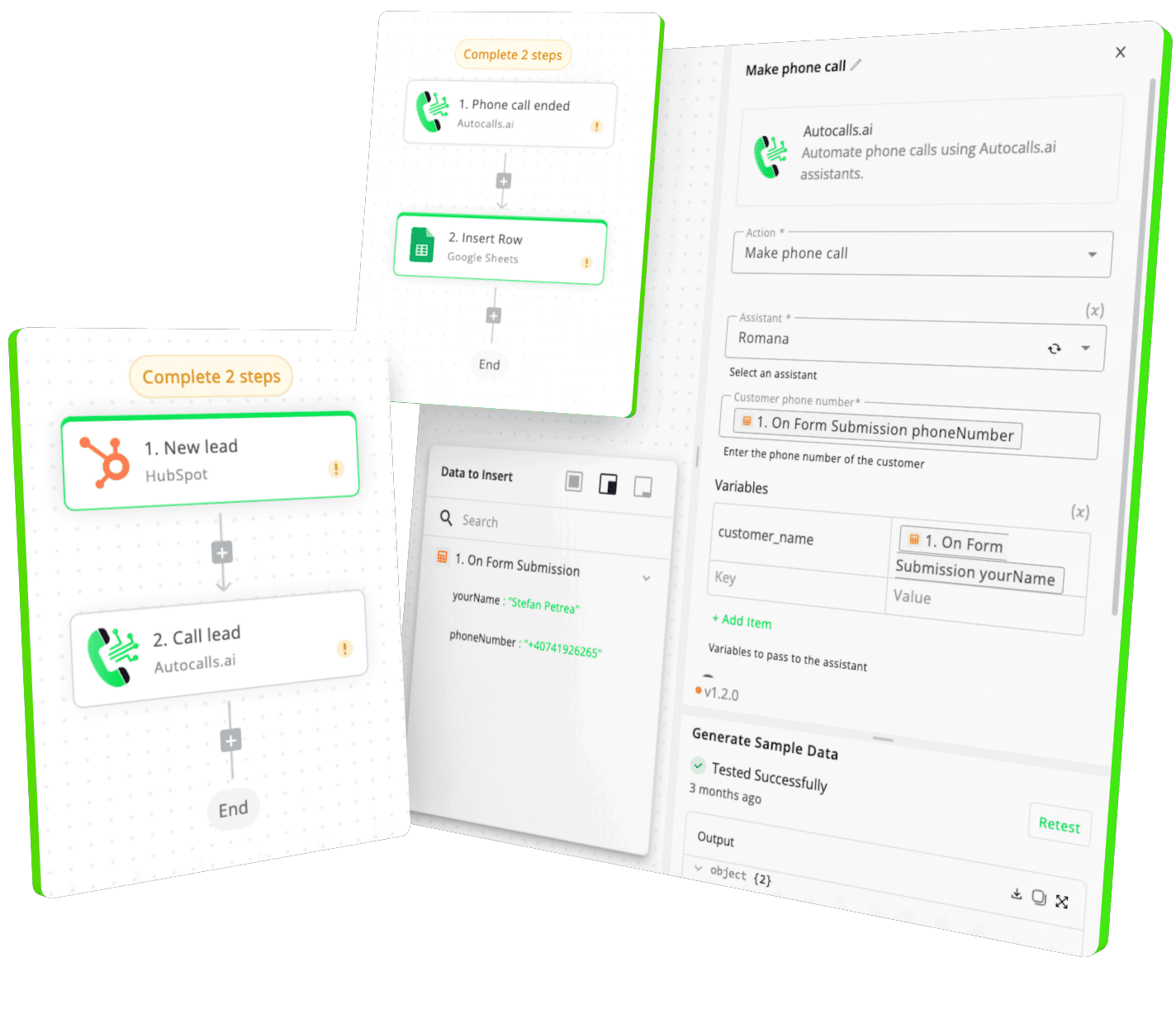
Easily manage AI voice agents without the need for programming skills.
Integrate with popular tools such as HubSpot, GoHighLevel, Zoho, Cal.com & +250 more and build automations using drag and drop.
+250 tools ready to integrate with your AI agents flow in our no-code platform, similar to Zapier or Make.
Have a question that is not answered? You can contact us at
Have a question? Contact usAn AssemblyAI phone integration connects your call recordings and voice workflows to AssemblyAI transcription and speech intelligence tools. It helps you turn phone conversations into searchable transcripts, summaries, and useful data for follow-up automation.
AssemblyAI auto dialer workflows let you analyze completed calls automatically after each conversation. You can transcribe recordings, search for keywords, and route the right leads or support cases faster.
Yes. You can use transcript retrieval, sentence and paragraph outputs, keyword search, and LeMUR tasks to pull out intent, objections, and action items from AI dialer conversations.
AssemblyAI phone automation reduces manual call review by turning recordings into structured, searchable data. That means quicker QA, better coaching, and faster customer follow-up without digging through hours of audio.
AssemblyAI call automation can handle transcript creation, subtitle export, keyword search, redacted audio retrieval, and AI-powered data extraction. These automations help teams improve reporting, compliance, and call outcome tracking.
Yes. An AssemblyAI voice agent setup works well for both inbound support conversations and outbound sales calls because it captures and organizes what was said after each interaction. This gives your team better records and more reliable next-step automation.
Join thousands of businesses already automating their phone calls with our
AssemblyAI integration.
You can get your assistant ready in few minutes.
The full path forward. Strategy, scripts, pricing, and the operating cadence agencies use to scale a white-label voice AI business. Free PDF, delivered to your inbox.